Die-Casting Tooling Design & Manufacturing
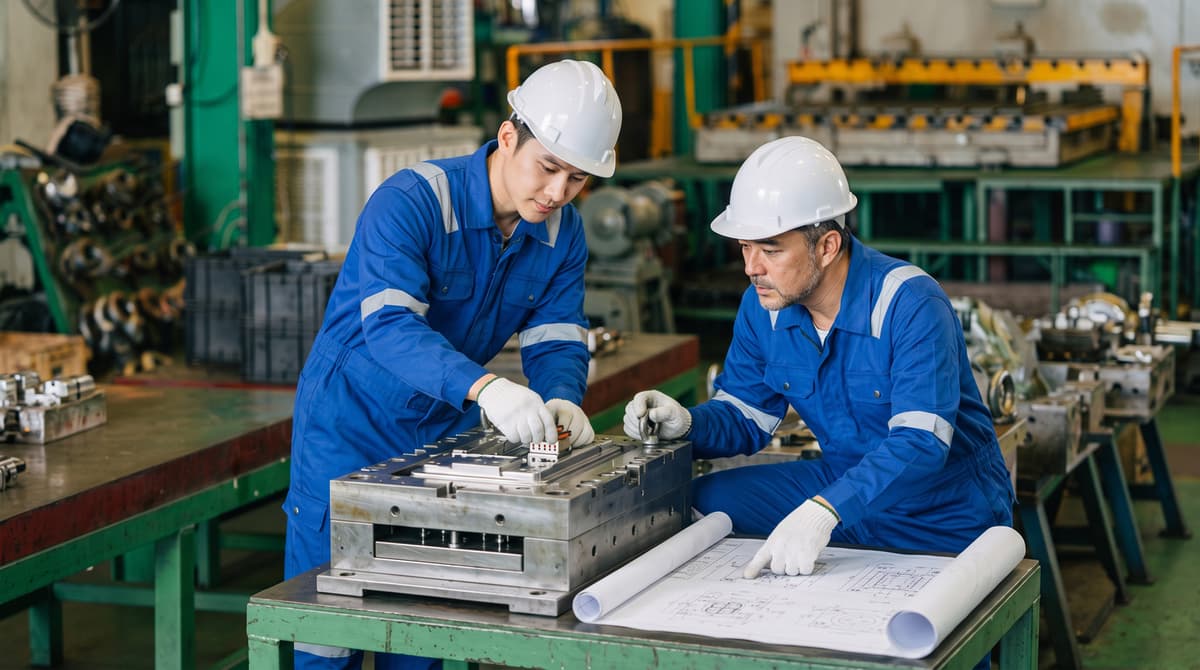
1. Aluminium & Zinc Alloy Die-Casting Mold Manufacturing
The design and production process of aluminium alloy die-casting molds is similar to that of general plastic injection moulds. However, due to the high melting point and strong fluidity of aluminium alloy soup, there are higher requirements in terms of heat resistance, exhaust and strength design.
Mold Development Schedule Estimate
● Mold making: It usually takes about 25-30 working days.
● Mold trial and confirmation: about 10 working days.
● Mass production delivery: about 30 working days after placing the order.
Mold Design Key Points And Precautions
● Draft angle: An appropriate angle must be reserved to facilitate demoulding.
● Cooling system: Reasonable cooling water path can shorten the molding cycle and stabilize the quality.
● Material selection: Based on the expected production volume, evaluate the mold life and select the corresponding grade of steel.
| Mold type | Application Scope | Common materials |
| Plastic injection mold | Electronic enclosures, daily necessities | P20 (economical), 718 (high precision), H13 (high temperature resistance) |
| Die-casting mold | Aluminium/zinc alloy parts, automobile and motorcycle accessories | H13 steel, special hot work die steel |
| Stamping die | Metal sheet forming, gasket | High carbon steel, tungsten steel (tungsten carbide) |
The design and production process of aluminium alloy die-casting molds is similar to that of general plastic injection moulds. However, due to the high melting point and strong fluidity of aluminium alloy soup, there are higher requirements in terms of heat resistance, exhaust and strength design.

Step 01.
Product Analysis And Mold Flow Simulation
Aluminium alloy has a large shrinkage rate during condensation and is prone to pores.
● Shrinkage compensation: Accurately calculate shrinkage Based on aluminium alloy grades such as ADC12, A380
● Mold flow analysis: simulate the liquid aluminium filling process and predict the locations of air entrainment, shrinkage cavities and cold joints
● Draft angle: Aluminium alloy is easy to stick to the mold, usually a larger draft angle needs to be designed (generally greater than 1°~2°)

Step 02.
Mold Structure Design
● Gating system: Aluminium die-casting requires extremely fast filling. When designing the runner and inner gate, it is necessary to ensure that the molten metal enters the mold cavity at a stable flow point.
● Exhaust and overflow well: A large overflow well is designed at the filling end to collect the cold metal liquid with impurities and air at the front end.
● Temperature control system: Aluminium molds need to withstand severe thermal expansion and contraction. A circulating hot oil circuit or water circuit must be designed to control the constant temperature of the mold and prevent mold cracking.

Step 03.
Material Selection And Heat Treatment
The material selection of aluminium alloy molds is the key to lifespan.
● Mold core material: usually high-grade hot work pressure steel, such as SKD61) or improved 8407.
● Heat treatment: Multiple tempering and quenching must be performed after rough machining. The hardness is usually required to be between HRC 44~48 to take into account both hardness and toughness

Step 04.
Processing Procedure
● Rough machining: remove a large amount of remaining material and leave a margin to cope with deformation after heat treatment.
● Heat treatment processing: Improve the strength of steel.
● CNC milling machine finishing: high-speed milling to final size.
● Electric discharge machining: processing deep cavities, reinforced ribs and other areas that cannot be processed by tools.
● Grinding and polishing: Reduce surface friction and facilitate demolding.
● Cutting processing: High-precision cutting of hard materials, used for products with complex shapes and high tolerances.
● Drilling machine processing: Drilling, reaming and tapping a wide range of materials to meet various needs.

Step 05.
\NSurface Treatment
In order to extend the life of the mold and prevent aluminium liquid from staining the mold, the surface of the mold core is often processed:
● Nitriding: Improve surface hardness and wear resistance.
● Coating treatment (PVD/CVD): Increase thermal barrier to reduce corrosion of steel by molten aluminium.

Step 06.
Trial And Adjustment
● Die-casting parameter adjustment: adjust injection speed, pressure and switching point.
● Dimensional measurement: Use CMM three-dimensional to confirm critical dimensions.
Design and production of zinc alloy die-casting molds. Due to its low melting point and good fluidity, zinc alloy is suitable for manufacturing castings with thin walls, complex shapes and high dimensional accuracy. Standard procedure for zinc alloy mold development:
Step 01.
Preliminary Evaluation And Design Analysis
Before developing the mold, it is necessary to conduct a manufacturability design analysis on the product drawings to reduce subsequent production risks:
● Structural review: Evaluate wall thickness uniformity to avoid shrinkage cavities, draft angle to ensure smooth demoulding, and undercut structure to evaluate whether sliders/tilt pins are needed.
● Mold flow analysis: simulate the molten zinc alloy filling process, predict the locations of pores, air entrainment and cold joints, and optimize the feed inlet and exhaust system accordingly.
Step 02.
Mold Structure Design
Draw a detailed mold structure diagram based on the analysis results:
●Flow channel and overflow well: Design the flow channel to control the flow rate, and set up an overflow well to store the front-end cold material and exhaust air.
● Cooling system: Configuring water channels to balance the mold temperature is crucial for production cycle and dimensional stability.
● Ejection system: Plan the position of the ejection pin to ensure that the product is evenly stressed and does not deform.

Step 03.
Mold Precision Processing
The mold body is mostly made of SKD61 or H13 high-heat working steel. The manufacturing process includes:
● Rough machining and heat treatment: Heat treatment is performed after preliminary cutting to improve the hardness and wear resistance of the steel.
● Precision machining: Use CNC milling machine, electrical discharge machining and wire cutting to complete the cavity and details.
● Polishing treatment: The surface of the mold cavity needs to be polished with high precision to obtain a good appearance and texture and facilitate demolding.

Step 04.
Mold Trial And Sample Acceptance (T1~Tn)
After the mold assembly is completed, the actual testing phase enters:
● T1 Trial mold: First injection sampling, check product size, presence of burrs, strains or unsaturated filling.
● Mold repair and optimization: Adjust mold parameters or structure according to the defects of the trial mold.
● Sample confirmation: After the size and appearance meet the standards, the customer will sign the sample.
Step 05.
Surface Treatment
● Mass production control: Monitor production stability through quality management systems such as ISO 9001.
● Regular maintenance: Although zinc alloy molds have a long life, they still need to regularly clean the surface carbon and check the ejector lubrication to extend their service life.
2. Mold Flow Analysis&Mold Structure Optimization
T0: First Test Internally
● After the mold development is completed, testing needs to be carried out in the factory first. The main purpose is to confirm the smoothness of the mold movement and basic molding.
● Check whether the mold opening and closing, slider movement, and ejection system are smooth, and confirm whether there is leakage in the cooling water line. The first sample does not require appearance and size. It mainly depends on the filling completeness to judge whether to correct local interference and adjust the mold.
T1: Send Samples To Customers To Verify Size And Structure
This is the most important mold trial to find out the gap between design and actual production.
● The molding parameters record the injection pressure, speed, mold temperature and cycle time in detail.
● Defect analysis shows whether there are pores, cold joints, shrinkage, or burrs on the appearance. Use the mold flow analysis results to compare and correct the position of the inlet gate or add an exhaust/overflow well.
● Conduct full-scale inspection, calculate whether the steel shrinkage is in line with expectations, and carry out mold repair and improvement based on the report.
T2: Focus On Surface Quality And Small Batch Production Stability
● Surface treatment test: If electroplating or baking paint is required, the T2 sample needs to be verified for surface treatment to confirm that there is no blistering or strain.
● Continuous production testing: Continuously sample hundreds of molds to confirm whether the product is still stable after the mold temperature is balanced.
● T2 improvement methods include detailed polishing, optimizing spray parameters, and adjusting cooling water flow
| Phase | Core Goals | Improvement Focus | Key data |
| T0 | Action confirmation | Mold mechanism, waterway | Smoothness of movement |
| T1 | Dimensions and structure | Shrinkage compensation, runner exhaust optimization | FAI Full Size Report |
| T2 | Appearance and mass productionability | Surface roughness, production cycle stability | CPK value, plating test |
- 1. Reduce Product Defects And Improve Quality
● Defect prediction: By simulating the flow and solidification of molten metal in the mold cavity, problems such as pores, cold joints, air entrainment and shrinkage cavities can be discovered in advance.
● Optimize appearance: For products such as zinc alloy that often require electroplating, mold flow analysis can ensure stable surface quality and improve yield.
- 2. Optimize Mold And Runner Design
● Inlet gate optimization: Accurately calculate the position and size of the inlet gate to ensure balanced filling and avoid erosion or incomplete filling caused by uneven flow rates.
● Exhaust and overflow well layout: Scientifically determine the positions of overflow wells and exhaust slots so that gas can be discharged smoothly.
● Cooling balance: simulates the effect of the cooling water path to prevent local overheating of the mold, thereby stabilizing product size and reducing deformation.
- 3. Shorten The Development Cycle And Reduce Costs
● Reduce the number of mold trials: Solve most design defects before the mold is officially opened, significantly reducing the time and cost of mold repairs and repeated mold trials.
● Reduce scrap rate: High stability can be achieved in the early stages of mass production, reducing material waste and scrap costs for subsequent secondary processing.
- 4. Improve Production Efficiency And Mold Life
● Shorten the molding cycle: optimize cooling and parameter settings, and shorten the holding pressure and cooling time while ensuring quality.
● Extend mold life: Avoid mold cracks caused by local stress concentration or thermal shock, thereby extending the service life of expensive molds.
- 5. Steel Determines The Life Of The Mold
Die-casting molds are exposed to extreme environments of high temperature, high pressure and high-speed erosion for a long time.
● Prevent thermal fatigue: If heat treatment is improper, cracks will quickly occur on the mold surface, which is also the most common cause of failure of die-casting molds. Good control can delay the occurrence of cracks and increase the life of the mold from 50,000 mold times to 100,000 or even 200,000 mold times.
● Prevent early cracking: If there are impurities inside the steel or insufficient heat treatment toughness, the mold may undergo overall brittle cracking in the early stages of production, causing serious financial losses.
- 6. Ensure Stable Product Quality
● Dimensional accuracy: Correct stress relief and tempering procedures can stabilize the steel structure, prevent minor deformation of the mold during mass production, and ensure consistent tolerances of parts produced in each batch.
● Surface texture: For zinc alloy parts that require electroplating or baking paint, the integrity of the mold surface is crucial. High-quality hardness control can reduce "mold sticking" and "strain" and reduce product defective rates.
- 7. Control The Economics Of Production
● Reduce the cost of downtime and repair: Once the mold is damaged, the cost of downtime repair, replacement of parts and re-trying of the mold is much higher than the initial investment in steel and heat treatment.
● Reduce secondary processing expenses: Stable molds produce less burrs and better surfaces, which can significantly save the labor and time costs of subsequent polishing and grinding.
3. Mold Modification, Renovation And Life Extension Services
01. Mold Modification Service
Structural adjustments in response to product design changes:
● Welding processing: Using professional laser repair welding for local meat addition, the heat affected zone is extremely small and the appearance can be accurately corrected.
● Replacement of inserts: Remove damaged or local structures that need to be changed, and re-make high-precision inserts for implantation to ensure that the dimensional accuracy is consistent with the original design.
● Flow channel optimization: According to the pore distribution after mass production, re-cut the flow channel or add an overflow well to completely solve the problem of poor filling.
02. Mold Renovation Process
When the mold has serious cracks or excessive burrs, it needs to be completely renovated:
● Disassembly and deep cleaning: remove carbon deposits, aluminium scale and scale, and conduct ultrasonic testing to evaluate the internal fatigue condition of the steel.
● Cavity grinding and polishing: Remove tiny thermal cracks on the surface, restore the mold surface smoothness, and reduce the risk of strain.
● Waterway dredging and rust removal: Use chemical cleaning or sandblasting to clean blocked waterways, restore cooling efficiency, and shorten the molding cycle.
● Mating surface correction: The mold clamping machine performs fine trimming on the mold parting surface to eliminate burrs and reduce the labor cost of subsequent burr removal.
03. Key Life Extension Technologies
● Stress relief tempering: Low-temperature tempering is performed during the renovation process to release the stress accumulated by long-term high-pressure impact and prevent overall fracture.
● Surface strengthening treatment:
● Ion nitriding: Improve surface hardness and erosion resistance.
● PVD Coating: Spray diamond-like carbon or titanium aluminium nitride to increase the smoothness of demoulding, especially suitable for complex structures or thin-walled parts.
● Replacement of key parts: Forced replacement of fatigued ejector pins, springs and guide posts to prevent major die accidents caused by breakage of small parts.
| Project | Mold Renovation | New mold opening |
| Cost | Approximately 20%–40% of a new mold's cost | 100% |
| Time | 1~2 weeks | 4~8 weeks |
| Benefits | Extend 50%~100% original life span | Restart life cycle |
*Cost-benefit ratio of renovation vs. new mold opening
4. Highly Complex Appearance/Mold Experience Of Structural Workpieces
Our company has rich experience in the development of difficult die-casting parts, and can effectively integrate product design, mold technology and mass production processes to provide customers with stable and high-quality die-casting solutions.
1. Complex structural parts development capabilities
With experience in making multi-hole positions, undercut structures, deep cavity designs and multi-slider core-pulling molds, it can effectively solve the molding and demoulding problems of complex structural parts.
2. Manufacturing of high-quality appearance products
According to the demand for appearance parts, the position of the parting line and the gate design are accurately planned to ensure the surface quality of the product and meet the subsequent surface treatment requirements such as polishing, electroplating, and baking paint.
3. Thin meat and precision structure technology
Our team has experience in the development of thin parts and structural products with different thicknesses. It can effectively control the metal flow and solidification process and reduce deformation and shrinkage problems.
4. Mold flow analysis and design optimization
Through mold flow analysis and engineering experience, gate, runner and exhaust design are optimized to improve filling efficiency and reduce the risk of air holes and cold isolation.
5. Integration of mold design and manufacturing
Integrate mold design, precision machining and trial mold adjustment to ensure mold accuracy and mass production stability, and shorten product development time.
6. Stable mass production and quality control
Establish a complete quality management mechanism from mold trial, first article confirmation to mass production process to ensure product dimensional accuracy and quality consistency.
If the die-casting factory has an in-house mold department, it can more accurately determine when to perform "preventive repairs" to avoid irreversible cracks in the mold. This is not only a cost saving, but also a strategic means to maintain stable product output. We have an integrated model of the die-casting plant and the mold department, which can more accurately determine when to perform "preventive repairs" to avoid irreversible mold cracks, maintain product stability, and have the ability to quickly adapt and optimize processes.
Key Areas of Importance:
Shorten the development time from design to mass production
● Zero time lag in communication: Designers, molders and die-casting masters can discuss at the same site and make immediate corrections to the product's "draft angle" or "thickness" to avoid misunderstandings and delays caused by external communication.
● Extremely fast mold trial feedback: When a defect is discovered during the mold trial (T1), the in-house mold factory can immediately dismantle the mold, repair the mold, reassemble it, and put it on the machine to try again.
Establish production-oriented mold design
● Machine adaptability: The in-house mold department can tailor the flow channel and cooling system according to the efficiency of the die-casting machine in the factory to ensure the best match between the mold and the equipment.
● Reduce mass production risks: Mass production experience will be incorporated into the mold design, and easy-to-replace inserts are designed in advance in areas prone to wear to reduce the frequency of future production line shutdowns.
Strengthen immediate repair and maintenance capabilities
● Reduce downtime losses: If the mold is crushed, broken needles, or aluminium material is eroded during mass production, our in-house team can perform precise repairs immediately to minimize downtime losses.
● Preventive maintenance: Through the data fed back from the production line, surface cleaning and stress relief treatment are regularly performed on the mold to effectively prevent early cracking of the mold and maximize the service life of the mold.
Guarantee core technology and customer assets
● Patent and technology confidentiality: The mold structure of high-end products such as communication equipment and new energy vehicle parts often involves patents. When produced in the factory, the drawings can be strictly controlled and not leaked out.
● Asset Management: It is crucial for customers’ mold assets to have a proper storage environment and professional records for orders from multinational companies.